Attenuation tanks
Carpark case study
Home » Case Study » Attenuation Tanks
- October 2, 2025
Discover how modern stormwater management solutions, such as attenuation tanks, can transform carpark drainage systems.
The case study shows how stormwater attenuation was incorporated into the drainage design for the carpark project.
Project Overview
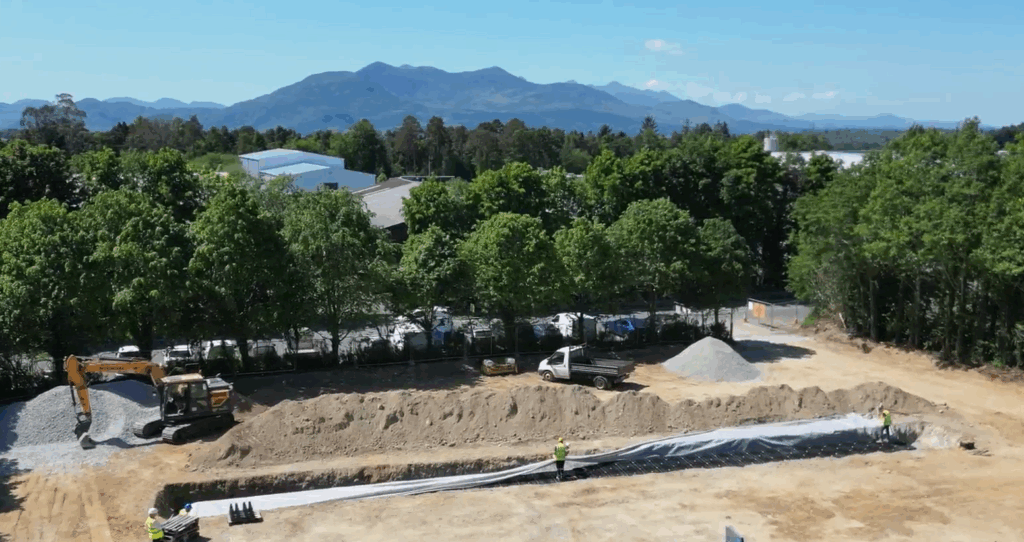
As part of the design for Tricel’s new 104-space carpark, an underground attenuation system was installed to manage surface-water runoff from the carpark.
Without attenuation, local drains and watercourses could become overwhelmed during heavy rainfall, significantly increasing the risk of flooding on-site and in surrounding areas.
Solution
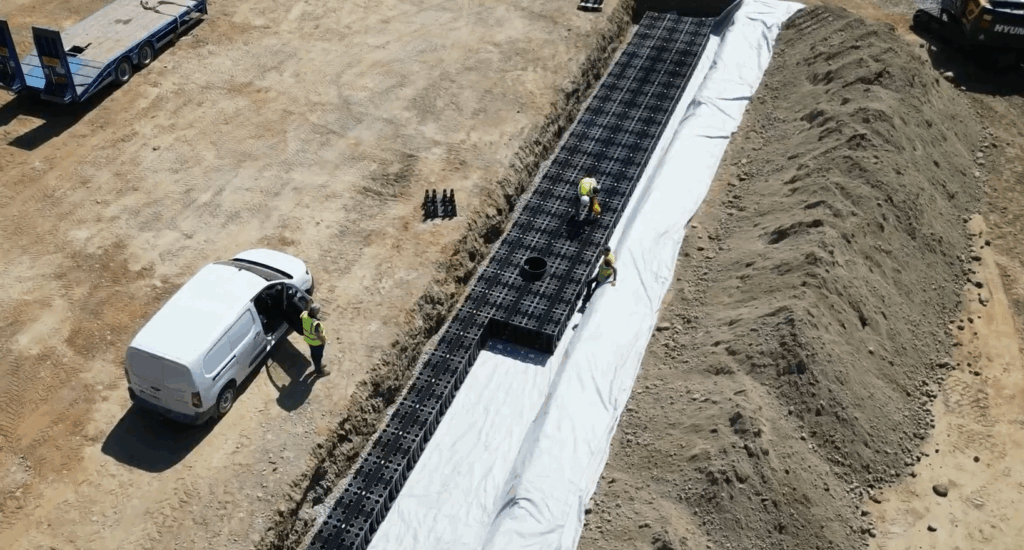
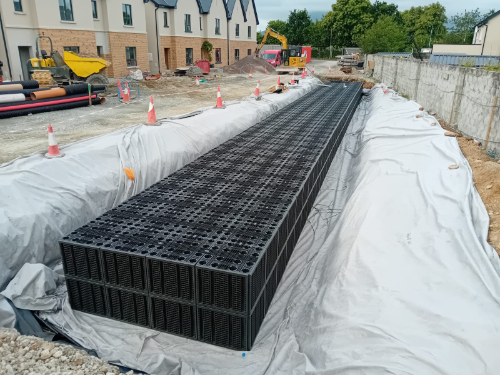
To address the high runoff volumes from the tarred carpark, the design adopted Tricel Rigofill ST-S crates (modular attenuation tanks) as the core of the system. These crates are part of Tricel’s storage/infiltration range and are well suited for trafficked areas.
Key attributes and how they were leveraged in this carpark project:
-
High Void Ratio (≈ 96 %)
Rigofill crates provide an exceptionally high storage-to-solid volume ratio, enabling efficient water storage in a relatively compact footprint. -
Modular & Flexible Design
The crate blocks, typically in 800 × 800 mm dimensions (full and half blocks), allow tailored layouts to meet the volumetric demands of the site. The modularity also supports horizontal and vertical stacking, adapting to varying depths under the carpark. -
Structural Strength & Traffic Load Capability
Rigofill systems are engineered to withstand heavy traffic loads (SLW 60 / HGV 60), making them fully appropriate for use beneath a carpark surface. -
Inspection & Maintenance Accessibility
The crates include a cross-shaped internal inspection tunnel that allows full access via camera or flushing equipment in two axes, enabling detailed inspection of both the drainage surfaces and structural components. -
Depth Capability
For deeper installations, Rigofill crates support installations up to depths of 4 m (or more depending on block type), enabling the system to fit under the carpark subgrade without excessive excavation.
By using Rigofill ST-S crates, the design achieved both efficient attenuation and structural robustness, while maintaining the ability to inspect and maintain the system over its operational lifetime.
Installation Process
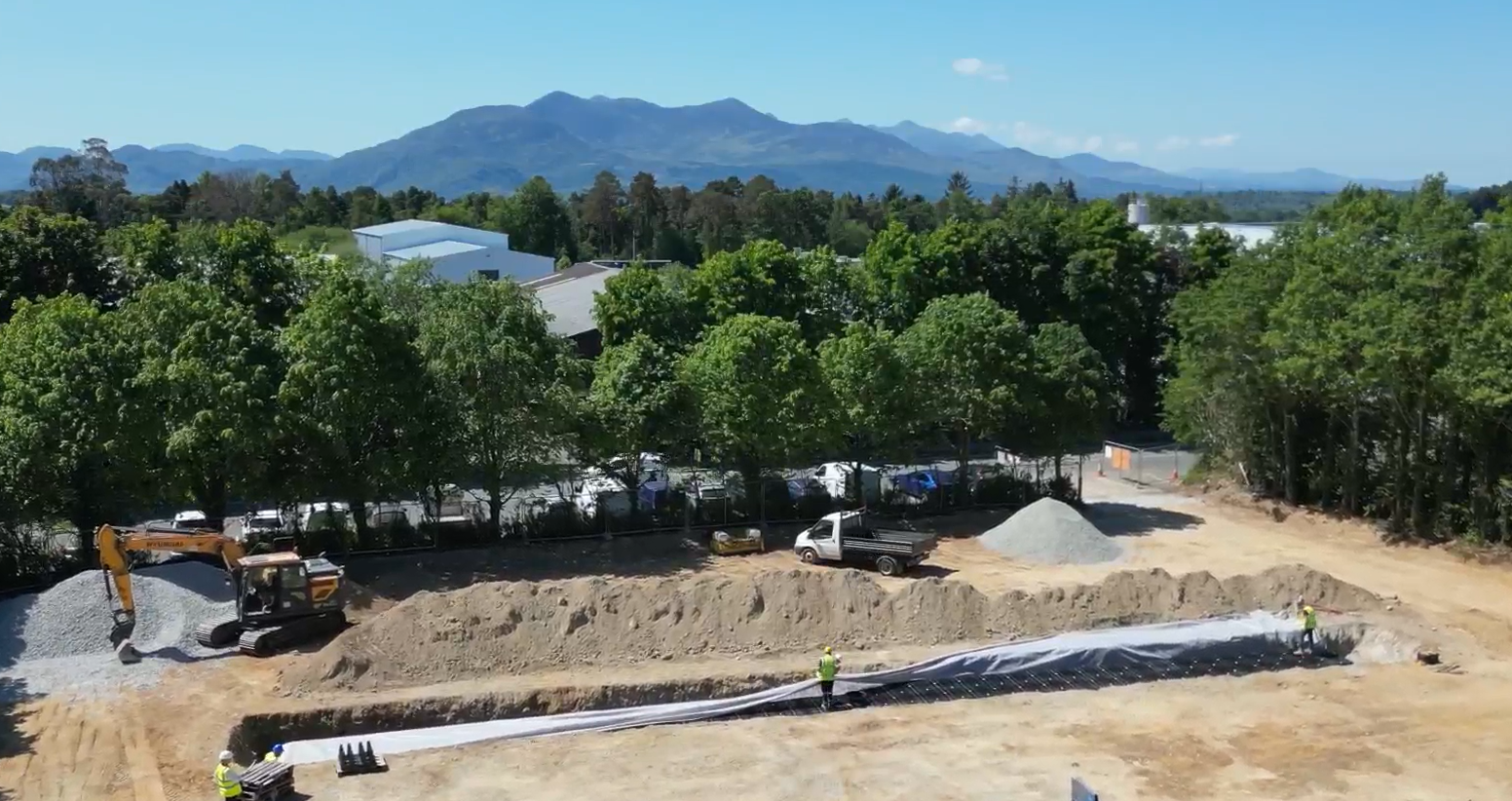
- Excavation & Preparation – The carpark sub-base was excavated and leveled to accommodate the attenuation system.
- Crate Installation – Modular attenuation crates were positioned and securely wrapped in a geotextile membrane.
- Drainage Integration – Inlet and outlet connections were made, including the overflow link to the local drainage network and the oil separator.
- Backfilling & Surface Restoration – The system was covered, compacted, and the carpark surface was reinstated for immediate use.
Conclusion
- Flood Prevention: The system prevents stormwater from backing up and flooding the carpark or adjacent properties.
- Environmental Compliance: The system provides on-site attenuation of surface-water runoff before controlled discharge.
- Pollution Control: The oil separator protects local watercourses from untreated pollutants.
- Planning Approval: Installation of attenuation tanks was instrumental in obtaining planning consent for the development
In this project, underground stormwater storage was integrated into the drainage design for the commercial development.
If you are planning a car park or similar development and require an effective stormwater management solution, get in touch with our team to discuss your project.
Other articles you may be interested in
- Case Study
- Stormwater
Key features
End to end solutions
Comprehensive systems that handles all phases of the process from start to finish
CERTIFIED
Complies with EN 17152-1
TECHNICAL EXPERTISE
Unrivalled technical expertise by our sales team regarding stormwater management solutions
If you have any questions or would like to discuss your project with us, don’t hesitate to get in touch.
Get in touch