
Uodated July 2026
Wastewater Treatment Systems
Septic Tanks Ireland
EN 12566 & S.R. 66 certified
Home » Sewage treatment plant construction
Sewage Treatment Plant Construction and Installation in Ireland
498,283
Registered domestic wastewater systems nationally, 2024
CSO, Domestic Waste Water Treatment Systems 2024
56%
Of inspected septic tanks failed in 2024, rising to 59% in 2025
EPA National Inspection Plan
+8.6%
Growth in new system registrations, 2024 vs 2023
CSO, 2024
This guide explains how a domestic sewage treatment plant is planned, selected, constructed, and installed for properties in Ireland that are not connected to the public sewer. It covers the site assessment and planning stage, how the correct system is chosen, what happens on site during construction and installation, the issues that most often cause delays, and what is required after the system is commissioned. It is written for homeowners, self-builders, architects, engineers, builders, and site assessors.
Off-mains properties need an approved treatment system
If a house cannot connect to the public sewer, its wastewater must be treated on site by an approved domestic waste water treatment system. In Ireland, the design, installation, and maintenance of these systems for single houses is guided by the EPA Code of Practice for Domestic Waste Water Treatment Systems (Population Equivalent ≤ 10), published in 2021. The Code sets out how a site should be assessed, how a system should be selected, and how it should be operated once installed.
There is no single system that suits every property. The correct choice depends on the outcome of the site assessment, the ground conditions, how the property will be used, the population equivalent (PE), the discharge route available, and the requirements of the local authority. This guide walks through each stage of that process, from the first site check to handover and maintenance.
When do you need a sewage treatment plant?
A sewage treatment plant is typically considered in the following situations:
- New builds that are not connected to the mains sewer. Most rural one-off houses in Ireland fall into this category, and the wastewater system must be addressed as part of the planning application.
- Replacement of older or failing systems. A system that is backing up, ponding, causing odours, or discharging inadequately treated effluent may need to be replaced.
- Compact sites. Where the site does not have the space or the ground conditions to support a septic tank and a suitably sized percolation area, a treatment plant may be the appropriate route.
- Upgrades where a higher level of treatment is required. Some sites, discharge routes, or local authority conditions call for secondary treatment rather than primary treatment alone.
- Planning or compliance-led situations. A planning condition, an inspection outcome, or a change in how the property is used can all trigger the need for a new or upgraded system.
Key point: In every one of these cases, suitability depends on the site assessment. The assessment determines what the ground can accept, what discharge route is available, and therefore which type of system is appropriate. No system should be selected before that assessment is complete.
Sewage treatment plant construction vs installation: what is the difference?
The two terms are often used interchangeably, but they describe different things.
Construction refers to the full project process. It starts with the site assessment and runs through system design, product selection, planning documentation, excavation, base preparation, installation of the tank, pipework, electrical connection, commissioning, and reinstatement of the ground. Construction is everything that has to happen for a working, compliant system to be in place.
Installation is one stage within construction: the physical work of placing the tank, connecting it, and preparing it for use. It is usually the most visible stage, but it depends entirely on the stages that come before it. An installation can only go smoothly if the assessment, system selection, and site preparation have been done correctly.
Why this matters : Many delays and cost overruns that appear during installation are actually caused by gaps earlier in the construction process, such as an incomplete site assessment or an unsuitable system choice.
The process before construction starts
Before any machinery arrives on site, the following steps should be completed:
TricelSiteAssessor.ie supports this stage of the process. It helps with site assessment documentation and planning preparation, so that the paperwork required by the local authority is in order before construction begins.
Open the toolChoosing the correct system for your site
In plain terms, the main options work as follows.
A septic tank provides primary treatment. It separates solids from the wastewater and allows partial breakdown of the retained material, but the effluent leaving the tank still requires further treatment in the ground through a properly designed percolation area. Septic tanks intended for the Irish market should comply with I.S. EN 12566-1, the standard for prefabricated septic tanks.
A packaged wastewater treatment plant provides a higher level of treatment. It treats the wastewater biologically within the unit itself, producing a better quality effluent before discharge to the receiving ground or other approved discharge route. Packaged plants placed on the market should be tested and certified in accordance with I.S. EN 12566-3, the standard for packaged and site-assembled domestic wastewater treatment plants.
Which route is correct depends on the site conditions and the regulatory requirements identified during the site assessment. Neither option is automatically better; each is suitable in the circumstances it was designed for.
Tricel product routes
An option where the site assessment confirms that a septic tank is suitable and the site has the required downstream treatment and discharge arrangement, such as a correctly designed percolation area.
The route for domestic sewage treatment where secondary treatment is required. The Novo is Tricel’s packaged treatment plant for single houses and is certified to I.S. EN 12566-3.
Where the project is not a standard domestic house, for example multiple dwellings, commercial premises, or community-scale loads, speak to Tricel directly about the appropriate product range and design support.
View all wastewater systemsKey point: No product suits every site. The site assessment, not the product brochure, should drive the selection.
Construction and installation: step by step
Once the system has been selected and the documentation is in place, the on-site work generally follows this sequence:

Installation note : Installation must follow the correct Tricel product manual and any site-specific engineering requirements identified during design. Where relevant national guidance such as S.R. 66 applies to the installation, it should be followed alongside the manufacturer’s instructions.
Choosing a Location for the Treatment System
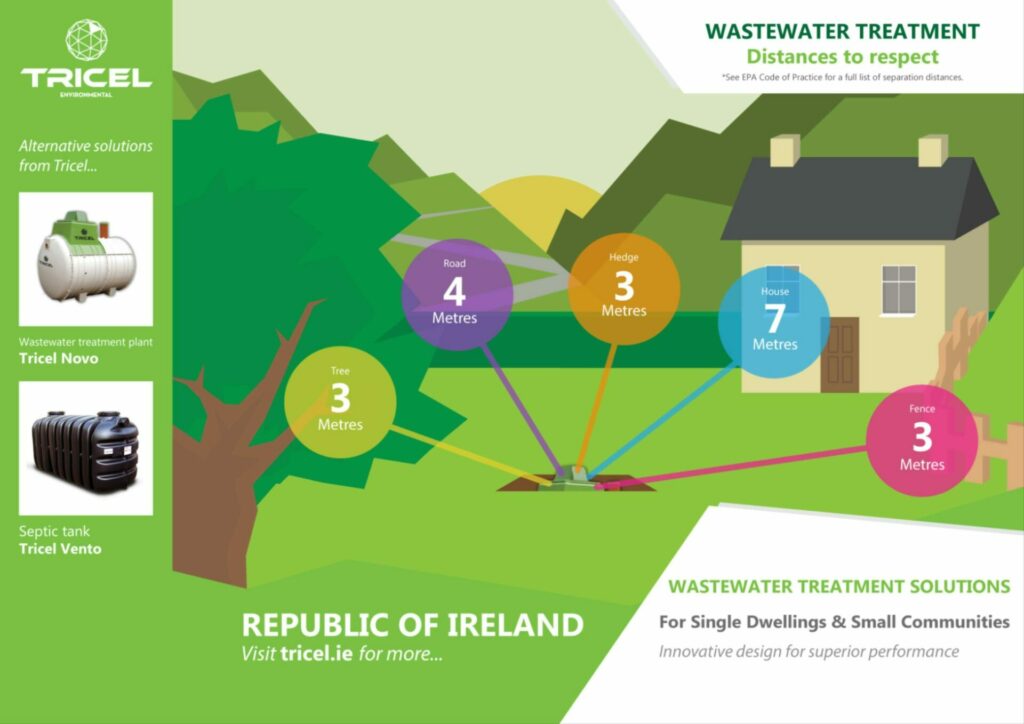
Before a wastewater treatment plant or septic tank is installed, the proposed location must be checked against the site layout, access requirements, boundaries, nearby structures, and the applicable EPA Code of Practice.
The image below gives a simple visual guide to common separation distances for domestic and small community wastewater treatment systems in the Republic of Ireland, including distances from a house, road, hedge, tree, and fence. It should be used as an initial planning guide only. Final system positioning should be confirmed by the site assessor, designer, and product installation requirements.
| Site feature shown | Indicative distance shown | Why this matters |
|---|---|---|
| House | 7 metres | Helps ensure the system is positioned with suitable clearance from the dwelling and remains accessible for inspection and maintenance. |
| Road | 4 metres | Allows appropriate separation from traffic areas and helps protect the tank, pipework, and access points. |
| Hedge | 3 metres | Reduces obstruction around the system and helps maintain access for servicing. |
| Tree | 3 metres | Helps reduce the risk of root interference and future access restrictions. |
| Fence | 3 metres | Supports suitable boundary clearance and access around the system. |
Installation note :These distances are indicative and do not replace a site-specific assessment. Separation requirements may vary depending on the wastewater system, ground conditions, discharge route, nearby services, boundaries, wells, watercourses, and the current EPA Code of Practice.
Common issues that delay installation
Most installation delays are avoidable. The issues below come up repeatedly on domestic projects:
- Poor access for delivery vehicles or machinery, discovered only on the day of delivery.
- Unexpected ground conditions, such as rock or soft ground that was not identified in advance.
- A high water table, which can affect excavation, base preparation, and the installation method.
- Incorrect system selection, requiring a change of product after the ground has been opened.
- Missing planning or site assessment documents, which can halt work until they are resolved.
- Insufficient discharge area for the treated effluent.
- Wrong invert levels between the house drain and the tank inlet.
- Unsuitable backfill material or backfilling carried out in the wrong sequence.
- The electrical connection not being ready when the system is due to be commissioned.
- Failure to follow the product installation manual.
Key point : Almost all of these trace back to preparation. A complete site assessment, the correct product for the site, and early coordination between the builder, installer, and supplier remove most of the risk.
Septic tank or sewage treatment plant?
The table below summarises the main differences. It is a general guide only; the correct route for a specific property is determined by the site assessment.
| System type | Treatment level | Typical use | Site considerations | Tricel product route |
|---|---|---|---|---|
| Septic tank | Primary treatment | Sites where the assessment confirms a septic tank with a percolation area is suitable | Requires suitable ground conditions and space for a correctly designed percolation area; complies with I.S. EN 12566-1 | Tricel Vento |
| Sewage treatment plant | Secondary treatment | Sites requiring a higher level of treatment than a septic tank provides | Requires a power supply and an approved discharge arrangement; certified to I.S. EN 12566-3 | Tricel Novo |
| Treatment plant with additional polishing or discharge requirements | Secondary treatment plus additional measures | Sites or discharge routes where further treatment of the effluent is required | Design confirmed case by case with the site assessor and local authority | Speak to Tricel |
Where a site or discharge route requires additional treatment beyond a standard packaged plant, for example further polishing of the effluent, the design should be confirmed with the site assessor and with Tricel before any product is ordered.
Key point : Almost all of these trace back to preparation. A complete site assessment, the correct product for the site, and early coordination between the builder, installer, and supplier remove most of the risk.

Wastewater treatment for a new build
For a new build, the wastewater system should be considered early, ideally before the planning application is prepared. The system affects the site layout, the location of the house and driveway, access for delivery and future desludging, the drainage design, the planning documents submitted to the local authority, and the installation schedule during the build.
Treating the wastewater system as an afterthought is a common and expensive mistake. If the percolation area or discharge route is not workable, it can affect whether planning permission is granted at all.
Use TricelSiteAssessor.ie to prepare the site assessment documentation your planning submission depends on.
Start your site checkReplacement and upgrade projects
Existing systems do not last forever. An older system may need to be replaced or upgraded if it is failing, undersized for the current occupancy, creating nuisance such as odour or ponding, or no longer acceptable for how the property is used. Extensions, changes of use, and property sales can all prompt a review of the existing system.
For replacement projects, the process is broadly the same as for a new installation: assess the site, confirm the PE and discharge route, select the correct system, and install it in accordance with the product manual. The existing system must also be decommissioned safely.
Maintenance after installation
Installation is not the end of the process. Every domestic wastewater treatment system needs correct use, periodic inspection, desludging at the intervals appropriate to the system and its loading, and maintenance in line with the product manual and the applicable regulatory requirements. The EPA Code of Practice makes clear that ongoing operation and maintenance are essential to keep a system performing as designed.
A well-installed system that is never serviced will eventually fail. Owners should keep records of desludging and servicing, and should ask their supplier what maintenance arrangements are available at the point of purchase, not after a problem appears.
Table of Contents
Planning a sewage treatment plant installation?
If your property is not connected to the mains sewer, Tricel can help you identify the right system route and understand the next steps for site assessment, product selection, and installation.
Our range of products
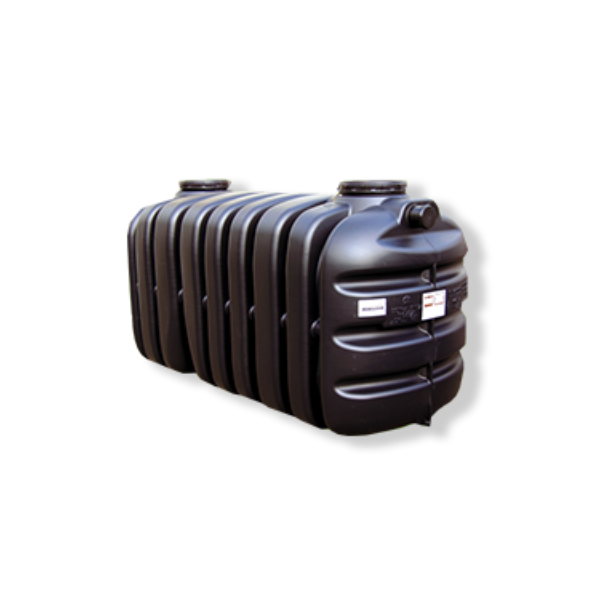
Tricel Vento Septic Tank
Shallow dig tank, strong & robust underground tank, No electrical or moving parts. Ideal for sites with good drainage & plenty of space.
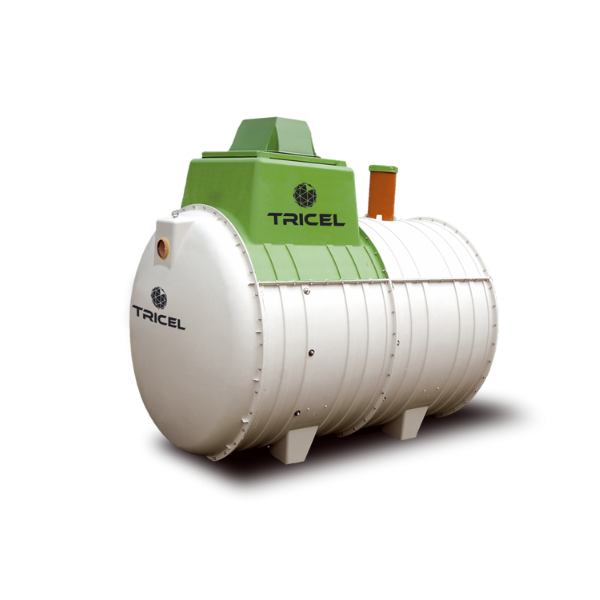
Tricel Novo Sewage Treatment Plant
Durable & long lasting SMC tank, shallow dig tank, easy installation (Plug and Play), long life components.
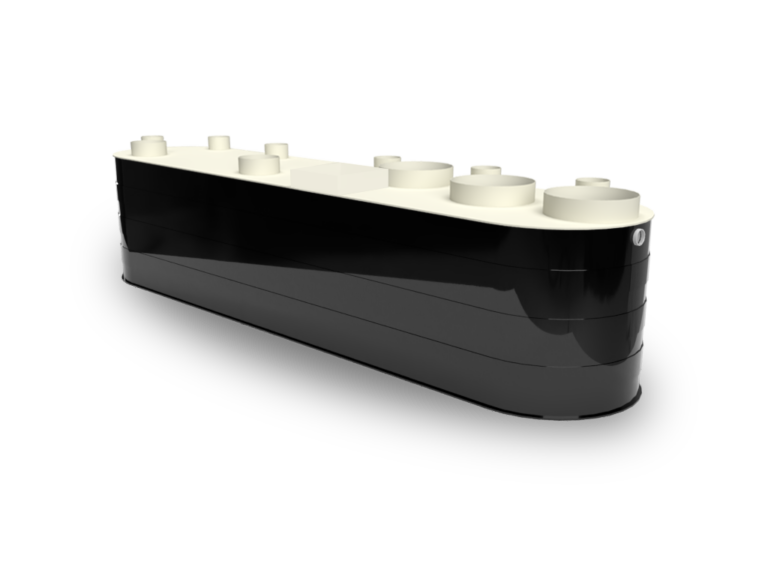
Tricel Maxus Sewage Treatment Plant
Commercial plant. Submerged Aerated Filter (SAF) technology. Ideal for project over 50 PE.
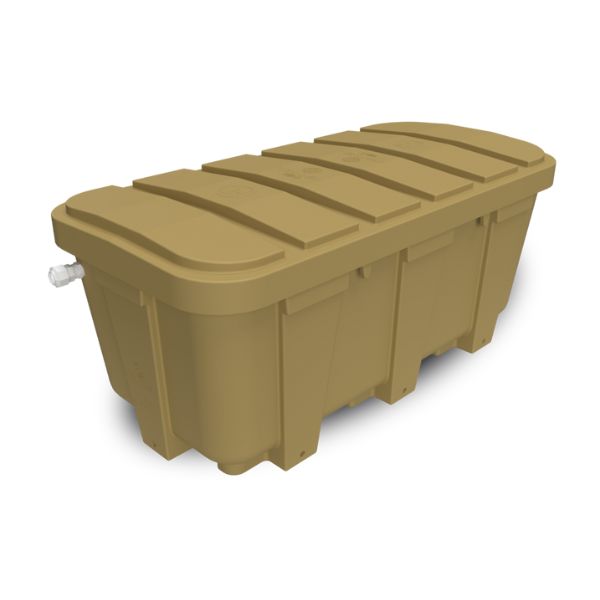
Tricel Tero Tertiary Treatment
An eco-friendly and modular system with proven E.Coli Treatment capabilities in line with the new EPA requirements.
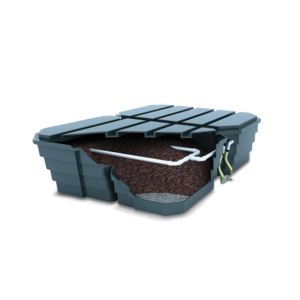
Tricel Puraflo Secondary treatment plant
Ideal for sensitive sites, compliant to Irish Standard, small footprint.
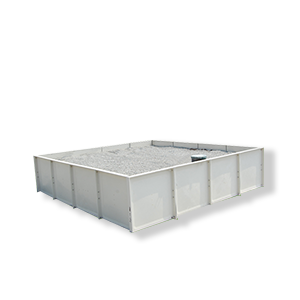
Tricel Sandcel
Sand Polishing Filter
Provides a dual function of polishing the effluent from a wastewater treatment system and disposing it into groundwater.
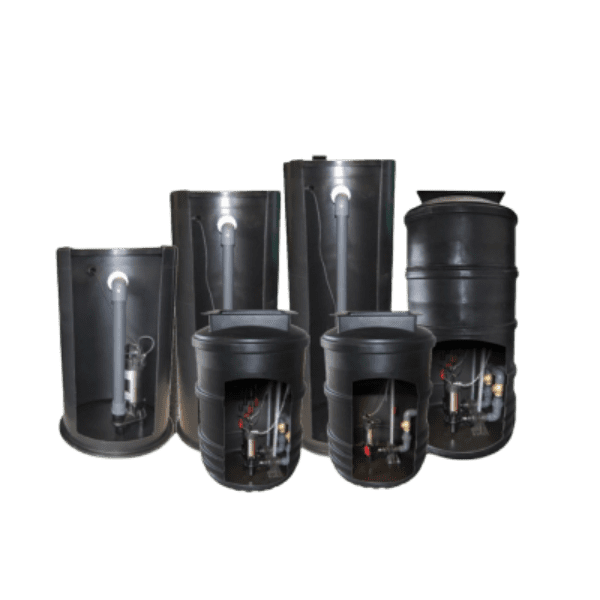
Tricel Pumping Stations
Pump fluids from one place to another where gravity drainage cannot be used, easy and trouble-free installation
Questions about sewage treatment systems
Your site, ground conditions, property type, PE and discharge route determine the right sewage treatment system. These FAQs explain the main differences between septic tanks, treatment plants, polishing filters and pumping stations.
What is involved in sewage treatment plant construction?
Construction covers the full project: site assessment, system design and selection, planning documentation, excavation, base preparation, installation of the tank, pipework and electrical connections, commissioning, and reinstatement. Installation is one stage within that wider process.
Is sewage treatment plant construction the same as installation?
No. Installation is the physical placing and connecting of the system on site. Construction includes everything before and after that stage, from the site assessment through to commissioning and handover.
Do I need a site assessment before installing a sewage treatment plant?
Yes. A site characterisation assessment, carried out in line with the EPA Code of Practice 2021, establishes the ground conditions, water table, and discharge options. The system should only be selected after the assessment is complete.
What type of sewage treatment plant do I need for a new build?
It depends on the site assessment. Some sites suit a septic tank with a percolation area; others require a packaged treatment plant providing secondary treatment, such as the Tricel Novo. The assessment and the local authority requirements determine the route.
Can I install a sewage treatment plant instead of a septic tank?
Often, yes, and on some sites a treatment plant is required rather than optional. Whether it is the correct route for your site depends on the assessment results and the discharge arrangement available.
What can delay a sewage treatment plant installation?
The most common causes are poor access, unexpected ground conditions, a high water table, missing documentation, wrong invert levels, unsuitable backfill, and the electrical supply not being ready. Most delays are prevented by thorough preparation.
Does a sewage treatment plant need electricity?
Treatment plants that use aeration, including packaged plants such as the Tricel Novo, require a power supply. A conventional septic tank such as the Tricel Vento does not require electricity to operate.
What happens after installation?
The system is commissioned, and the owner receives handover documentation and maintenance guidance. After that, the system needs correct use, periodic inspection, desludging where required, and servicing in line with the product manual and regulatory requirements.
Can Tricel help with planning documentation?
TricelSiteAssessor.ie supports site assessment documentation and planning preparation, and Tricel can advise on the product information required for a planning submission. It does not replace a qualified site assessor.
Which Tricel product is suitable for my site?
That depends on the site assessment. Where a septic tank is suitable, the Tricel Vento is the septic tank route. Where secondary treatment is required, the Tricel Novo is the treatment plant route. For anything beyond a standard domestic house, contact Tricel directly.
Why choose Tricel?
Irish manufacturing. Nationwide support. Guaranteed compliance.
Tricel has manufactured wastewater treatment systems in Ireland since 1973, from its facility in Killarney, Co. Kerry. The Vento septic tank range and Novo treatment plant range are certified to EN 12566 for installations from single homes up to 50+ population equivalent.
A nationwide network of approved distributors and installers, backed by Tricel's own technical sales team, covers supply, installation, commissioning and servicing across every county.
Quality
Manufactured in Killarney, Co. Kerry. The Novo tank is built from compression-moulded SMC — a composite material proven over 50 years in harsh operating conditions.
- EN 12566-1 (septic tanks) and EN 12566-3 (treatment plants) certified
- Independently tested by PIA GmbH, Aachen, Germany
Efficiency
The Tricel Novo treats wastewater across three independent zones, reaching an average 95.9% BOD removal — a higher standard of treatment than a septic tank alone.
- No moving parts or pumps inside the tank
- Ceramic diffuser lasts twice as long as standard rubber equivalents
Support
A nationwide network of approved distributors and installers, with a dedicated technical sales team on hand for sizing, site queries and project support.
- County-based distributor network across Ireland
- Direct technical support from Tricel's own team
Maintenance
Servicing and technical advice available directly from Tricel's environmental team, for the lifetime of your system.
- 10-year warranty on the Vento septic tank
- Call 064 663 2421 for servicing or technical advice
Related resources
Everything else you might need
Grants & funding
Eligibility, the 85% / €12,000 grant, and how to apply after a failed inspection.
Grants guide →Cost & pricing guide
A fuller breakdown of product, installation and groundworks costs by system type.
Read the cost guide →Find an installer
Regional installer and distributor network across the seven highest-demand counties.
Find an installer →Service & desludging plans
One to ten-year service agreements, from €195, covering travel and servicing labour.
View service plans →Site assessment
Use the free Tricel Site Assessor tool to check which wastewater treatment system category your site may fall under, based on the EPA Code of Practice
Start assessment →Case studies
Recent domestic and commercial installations, by county and sector.
Browse case studies →Meet our team
To find a technician in your area, visit our page
TALK SEWAGE TREATMENT
To speak to one of our agents online, click here
ASK FOR A QUOTE
Request a free quote today to have a quote that meets your project!