
Updated July 2026
Domestic Treatment Systems
Septic Tanks Ireland
EN 12566 & S.R. 66 certified
Home » Commercial Wastewater Treatment Systems Ireland | Maxus | Tricel
Commercial & 50+ PE · Ireland
Commercial wastewater treatment for off-mains sites
Commercial sites place a higher load on a wastewater system than a single home. The right system depends on site use, population equivalent, daily flow, wastewater strength, discharge route, ground conditions and the requirements of the relevant authority. For projects above 50 PE, the Tricel Maxus range is the main route.
Who this is for
Is this the right page for your project?
This page is for commercial, semi-collective and high-load sites. Tricel’s current commercial content lists these as typical applications.
- Hotels, guesthouses and tourism accommodation
- Nursing homes and care facilities
- Caravan parks, campsites and holiday parks
- Workplaces, factories and rural businesses
- Schools, crèches and community buildings
- Housing developments above the domestic threshold
- Restaurants, cafés and food-led premises
- Sites with seasonal or fluctuating wastewater loads
- Garden centres and visitor centres
- Petrol stations and retail units
Quick response
When a commercial system is needed
A commercial system may be required where the site is not connected to a public sewer, where an existing septic tank or treatment system is no longer suitable, or where the wastewater load has changed through expansion, higher occupancy, food preparation, washdown, laundry or seasonal peaks.
Why assess commercial separately?
The EPA Code of Practice applies to domestic systems up to 10 PE. Commercial, semi-collective and higher-load projects are assessed separately, because the load, discharge requirements and documentation differ.
How is the system chosen?
Not by product name alone. The system is sized and specified from site data — expected flows, load pattern, wastewater strength, discharge point and future use.
What does Tricel use above 50 PE?
The Maxus range, using Submerged Aerated Filter, or SAF, technology, in either an all-in-one Combi arrangement or a multi-tank layout depending on the site.
Does the region matter?
Yes. Product naming, documentation, approvals and discharge requirements can differ between the Republic of Ireland and Northern Ireland. Confirm the region before specifying a system.
Design inputs
What affects commercial wastewater system design?
Seven factors shape the specification. Each should be confirmed from the site data before a Maxus configuration is recommended.
Location
Republic of Ireland or Northern Ireland. Northern Ireland systems require NIEA consent to discharge; in the Republic, requirements depend on the discharge route and site type, and a trade effluent licence may apply to discharge to sewer.
Population equivalent
PE expresses the load the system must treat. Commercial PE may account for staff, visitors, pupils, covers, seats, shifts, guest rooms, pitches, production activity or other site-specific use.
Flow pattern
Constant use, short peaks, seasonal operation or long quiet periods. A school, hotel, factory, restaurant, caravan park and nursing home each produce different flow patterns, which affects settlement, buffering and control settings.
Wastewater strength
Food-led premises, factories, kitchens, laundries and washdown areas can create different levels of BOD, suspended solids, fats, oils, grease, phosphorus, ammonia or other parameters.
Discharge route
Discharge to ground, watercourse, sewer or another approved route affects the treatment level and documentation required. The route should be confirmed before the system is specified.
Site constraints
Footprint, access, levels, ground conditions, groundwater, existing services, opening times and phasing all affect whether the system runs by gravity or needs pumping, and whether an all-in-one or multi-tank layout suits.
Future expansion
The system should be reviewed against current and expected future use — important for hotels, visitor sites, factories, schools, housing developments and phased projects.
The product route
Tricel Maxus commercial wastewater treatment
The Maxus range is used for applications greater than 50 PE, using SAF technology and available in different layouts depending on site requirements. Standard listed sizes run from 66 PE to 560 PE, with each system designed to suit the project.
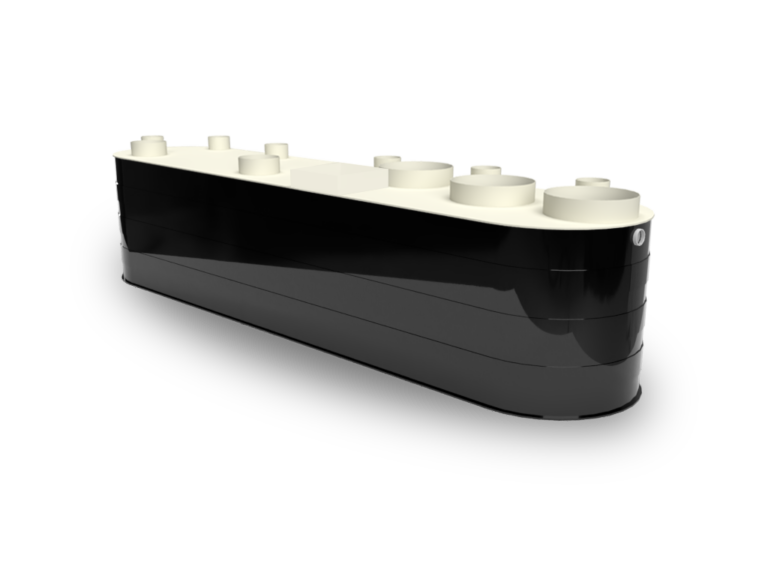
Maxus Combi
An all-in-one treatment plant. May suit projects where a more compact arrangement is required and the site can accommodate the selected model.
Maxus Combi product page →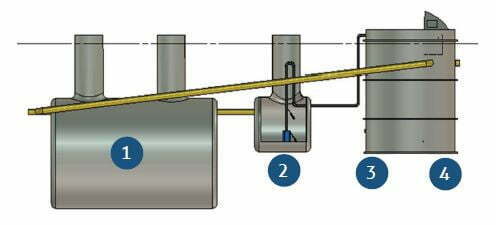
Maxus multi-tank system
Separates the settlement, buffer, biological treatment and clarification stages. Suits larger or more complex sites where layout, load pattern, discharge standard or installation constraints require a project-specific design.
Maxus multi-tank product page →How it works
How the Tricel Maxus works
The Maxus and Maxus Combi use a four-stage treatment process.
Settlement
Wastewater enters the settlement tank. Heavy solids settle as sludge, while oils, fats and grease rise and are retained.
Buffering
Partially treated wastewater enters the buffer tank, which evens out flow fluctuations before wastewater is pumped forward.
Biological treatment
The submerged aerated filter provides a large surface area for microbial activity, with aeration supporting the process.
Clarification
Remaining sludge settles out. Airlift pumps recirculate it to the settlement tank. Treated liquid is ready for discharge, subject to the approved design.
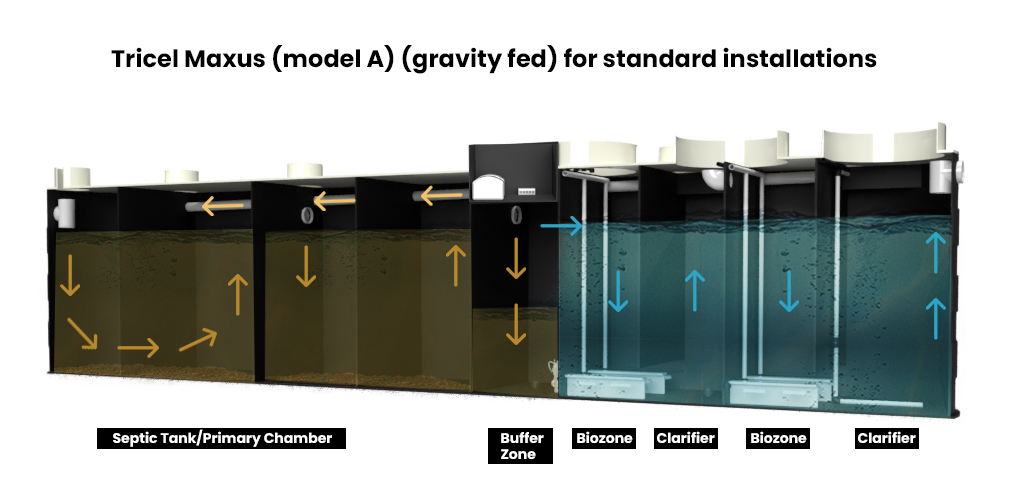
Dimensions Tricel Combi Model A, for standard installations.
Invert level on Model A is 520mm, which is used for installations where the system is placed low on the ground, which makes it possible to gravitate to the system, or if the water is pumped to the system.
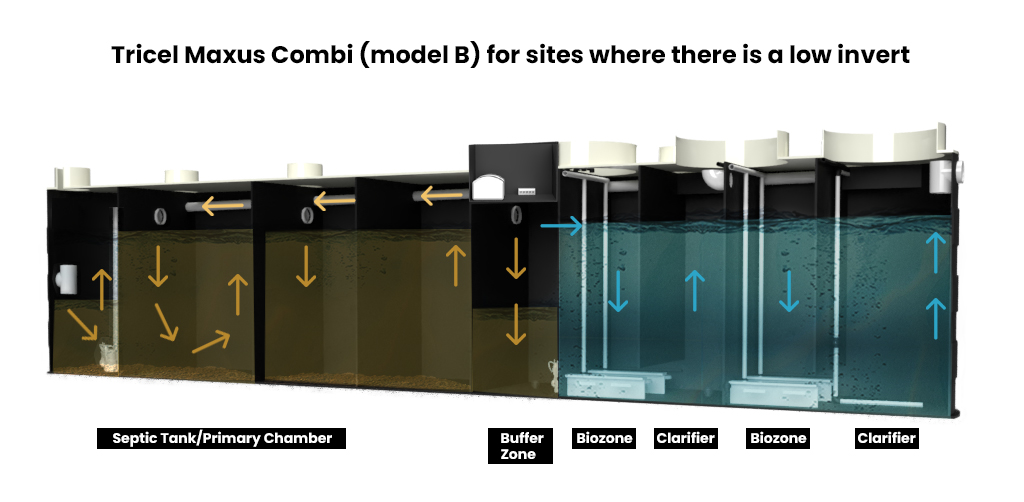
Dimensions Tricel Combi Model B, for sites where there is a low invert, avoiding the use of risers and minimising the risk of surface water entering the tank.
Invert level on Model B is 1620mm and is used where water can’t gravitate to Model A but will be able to gravitate to Model B inlet without being pumped.
In practice
Commercial examples
Commercial projects can differ widely, even when they use the same product range.
Meadowfield Caravan Park
Required a system for changing flows across peak and quiet periods, a small footprint, and installation during the closed season.
Read case study →Camping Moenbroen
Required a 50 PE treatment system for seasonal campsite flows, with high summer demand and low winter loading.
Read case study →Cheese processing factory
Required flow data, effluent strength, laboratory results, and information on shifts and washdown periods before a proposal could be prepared.
Read case study →Hotel treatment upgrade
A 92 PE Maxus system with a buffer tank was specified to meet the required treatment level, replacing an older arrangement.
Read case study →Horse & Hound Hotel
Required a hotel wastewater treatment upgrade using Maxus units, pumps, dosing and additional polishing before ground discharge.
Read case study →Kells Bay House and Gardens
Required a compact wastewater treatment arrangement for multiple wastewater sources, limited space and high effluent quality requirements.
Read case study →Seasonal commercial site
Required a wastewater treatment plant for seasonal use, with high water table conditions, pumping needs and telemetry requirements.
Read case study →Commercial wastewater upgrade
Used a Novo IE30 wastewater treatment plant and Puraflo modules to upgrade an existing obsolete wastewater treatment system.
Read case study →Food distribution wastewater upgrade
Used a Novo wastewater treatment plant and Sandcel sand polishing filter to replace a non-performing wastewater system.
Read case study →Claran National School
Required a septic tank and Puraflo module installation as part of a school wastewater upgrade linked to an extension.
Read case study →Lurga National School
Required a septic tank upgrade using a Novo wastewater treatment plant and Sandcel filter for a school extension project.
Read case study →Before we can size
What Tricel needs to size a commercial system
To review a commercial project, provide as much of the following as possible:
- Project location and jurisdiction
- Property type and current site use
- New build, replacement, upgrade or expansion
- Expected PE or design occupancy
- Daily flow estimate
- Peak and quiet operating periods
- Staff, visitors, seats, rooms, pitches, pupils, residents or shifts
- Kitchen, laundry, washdown or production activity
- Available wastewater test results, where relevant
- Proposed discharge route
- Planning, licence or consent requirements identified
- Site layout, levels, access and space constraints
- Whether future expansion is expected
Get the right system for your site — and a written quote
Every site is different. Book a free, no-obligation visit and a Tricel engineer will assess your site, recommend a suitable certified system, and provide a written quote.
Jurisdiction
Ireland and Northern Ireland: confirm the region first
Wastewater requirements differ between the Republic of Ireland and Northern Ireland, so the region should be confirmed before any product is selected.
| Project location | What to check first | Why it matters |
|---|---|---|
| Republic of Ireland | Site type, PE, discharge route, local authority requirements, and EPA Code of Practice requirements where relevant. | Commercial projects may fall outside the domestic EPA Code of Practice route and may need separate discharge or trade effluent review depending on the discharge route. |
| Northern Ireland | Northern Ireland wastewater treatment requirements , NIEA consent to discharge, and correct regional product documentation. | DAERA guidance states that private sewage treatment systems, including septic tanks and package treatment plants, require NIEA consent. |
Working on a Northern Ireland project? Confirm the correct product and documentation before specifying the system. Product naming and approvals may differ from the Republic of Ireland route.
The approach
Why use a project-specific commercial design?
A commercial system should be designed around the actual site. A standard product size may not be enough if the site has high-strength wastewater, uneven flow, limited installation space, future expansion, or a stricter treated effluent requirement.
For this reason, Tricel reviews the PE, flow, treatment level, site constraints and discharge requirements before recommending the most suitable Maxus configuration, and advises on the best option based on PE, treatment level and site constraints.
Table of Contents
Get Started
Not sure which system is right for your site?
A site assessment, rather than product preference, determines whether a septic tank or wastewater treatment plant is the correct route for your project.
Meet our team
To find a technician in your area, visit our page
TALK SEWAGE TREATMENT
To speak to one of our agents online, click here
ASK FOR A QUOTE
Request a free quote today to have a quote that meets your project!
Commercial wastewater FAQs
What is a commercial wastewater treatment system?
It treats wastewater from a business, organisation, development or shared site where a mains sewer connection is not available or the existing system is not suitable. It is sized around the site's load, flow pattern, treatment requirements and discharge route.
What is the difference between domestic and commercial treatment?
Domestic treatment is normally based on household occupancy and domestic use. Commercial treatment may need to account for staff, visitors, pupils, guests, seats, pitches, shifts, kitchens, laundry, washdown, trade effluent, peak periods and future expansion.
What PE is Tricel Maxus suitable for?
Tricel positions the Maxus range for applications greater than 50 PE. Current listed sizes include 66 PE to 560 PE, with each system designed to suit the project requirements.
Can Maxus handle seasonal loads?
Yes. Tricel's current Maxus content states that Maxus suits seasonal or constant loads and that the control panel adjusts to the incoming load — relevant for campsites, caravan parks, hotels and other properties with changing occupancy.
What information is needed for a commercial quote?
Usually the site location, property type, PE, expected flow, peak loading periods, wastewater strength where relevant, discharge route, site layout and any planning or discharge requirements already identified.
Can a commercial site use a septic tank?
Some sites may use primary treatment as part of a wider design, but a septic tank alone may not provide the treatment level required for a commercial or high-load site. Final selection depends on the site assessment, PE, discharge route and regulatory requirements.
Does commercial wastewater need a discharge licence?
It depends on the jurisdiction, site type, discharge route and wastewater characteristics. Trade effluent discharged to sewer may require a licence setting limits on volume, strength and characteristics. In Northern Ireland, private sewage treatment systems require NIEA consent.
Is the same product used in Ireland and Northern Ireland?
Not always. Product names, approvals and documentation may differ. Confirm the project location before specifying a system.
Can Tricel design for factories or food production sites?
Yes, but these sites normally need more detailed wastewater information — for example flow pattern, total flow, BOD, suspended solids, phosphorus, ammonia and treated effluent requirements — before a proposal can be prepared.
Can a commercial system be upgraded later?
Potentially, but it depends on the original design, available space, treatment requirement, hydraulic capacity, and discharge consent or licence conditions. Future expansion should be discussed at the sizing stage.
Get in touch