
Updated July 2026
Northern Ireladn Compliance
Domestic & commercial
Site-led costing
Home » Wastewater Treatment Systems Northern Ireland | Septic Tanks & NIEA Consent
Jurisdiction: Northern Ireland
Wastewater Treatment Systems in Northern Ireland
Wastewater treatment in Northern Ireland follows a different regulatory route from the Republic of Ireland. If a house, business, development or rural site is not connected to the public sewer, the system should be reviewed around the site location, property use, wastewater load, discharge route and Northern Ireland consent requirements before a septic tank or sewage treatment plant is selected.
For Northern Ireland sites, this usually means checking whether a public sewer connection is available, whether NI Water should be contacted, whether NIEA consent to discharge is required, and whether trade effluent consent applies. DAERA states that the discharge of trade or sewage waste to a waterway, or to water contained underground, requires consent from the Department where the premises are not connected to the public sewer.
Tricel can help homeowners, developers, consultants, installers and commercial site owners review the likely wastewater route before a product recommendation is made.
Wastewater treatment for Northern Ireland sites
This page is for Northern Ireland projects where a mains sewer connection is not available, not feasible at the required stage, or needs further review. It applies to a wide range of off-mains sites, including:
- Single houses and replacement domestic systems
- Rural homes, self-builds and extensions
- Housing developments and shared residential schemes
- Schools, creches and education sites
- Campsites, caravan parks and glamping sites
- Hotels, guesthouses and hospitality properties
- Nursing homes and care facilities
- Restaurants, cafés and pubs
- Garden centres, farm shops, depots, workshops and other rural businesses
The correct starting point depends on the actual wastewater load and discharge route. A single dwelling should not be assessed in the same way as a housing development, campsite, hotel, nursing home or mixed-use commercial site.
Related: Household wastewater treatment | Commercial wastewater treatment | Property type hub
Northern Ireland is not the same as the Republic of Ireland
A common mistake is to apply Republic of Ireland septic tank registration language to a Northern Ireland project. The two routes are different.
In the Republic of Ireland, domestic wastewater treatment systems are linked to registration, the EPA Code of Practice, local authority inspection and grant schemes where applicable. In Northern Ireland, the key issue for an off-mains private sewage treatment system is consent to discharge through the Northern Ireland Environment Agency route.
This means a Northern Ireland page should not rely on Republic of Ireland domestic registration wording. It should refer to NIEA consent, NI Water checks, trade effluent consent where relevant, and the specific discharge route for the site.
See also: Republic of Ireland vs Northern Ireland wastewater regulations compared
When is a private wastewater treatment system needed?
A private wastewater treatment system may be needed where a property or site cannot connect to the public sewer. This could involve a septic tank, package sewage treatment plant, larger commercial wastewater treatment plant, pumping arrangement, tertiary treatment or polishing stage, depending on the site.
NI Water states that where a mains sewerage system is not available, domestic sewage may be drained and treated in a private wastewater treatment system. NI Water also states that the siting of a septic tank or package treatment plant, and permission to discharge effluent, must be agreed with the Northern Ireland Environment Agency Pollution Control Branch.
The treatment system should not be selected on property type alone. Before choosing a system, the project should confirm:
- Whether a public foul sewer connection is available
- Whether the site is domestic, commercial, mixed-use or development-scale
- Population equivalent and peak loading
- Wastewater strength
- Whether kitchens, laundry, washdown areas or public toilets are involved
- Ground conditions and available space
- Discharge route
- Consent, planning and building control requirements
- Maintenance and servicing access
NIEA consent to discharge
For Northern Ireland off-mains wastewater sites, NIEA consent to discharge is central. Septic tanks and sewage treatment plants are not only product decisions; they are also discharge decisions.
DAERA states that septic tank systems require consent to discharge from the NIEA Water Regulation Team to make sure the discharge is not going to cause pollution or public health issues. DAERA also states that consent is required for a discharge of sewage effluent from a house or other premises to a waterway or to underground strata, and that failure to obtain consent is an offence.
Consent requirements can depend on where the treated effluent will go, the volume and nature of the discharge, and the receiving environment. A discharge to ground, groundwater, surface water, watercourse or another route may each raise different technical and regulatory considerations.
For this reason, a Northern Ireland wastewater project should start with the site and discharge route, not with the assumption that a standard domestic septic tank route will apply.
Public sewer connection and NI Water checks
Where a public foul sewer is available, connection to the sewer may need to be considered before a private treatment system is pursued. For new development, capacity and connection issues may need to be checked with NI Water.
NI Water states that Single Unit Pre-Development Enquiry applications can be made to obtain information about the availability and capacity of water and sewerage infrastructure for future development. NI Water will advise whether existing infrastructure can accommodate the proposed development and provide anticipated connection points.
For multi-unit developments and commercial projects, the sewer position is especially important. DAERA states that domestic consents are for single-dwelling discharges only, and that for sites of two or more dwellings, advice should first be sought from NI Water regarding connection to the public sewer network.
A housing development, apartment scheme or shared residential project should therefore be reviewed separately from a single house.
Related: Housing development wastewater treatment | Commercial wastewater treatment
Trade effluent in Northern Ireland
Commercial sites may need more than domestic sewage treatment review. Where trade effluent is discharged to a public sewer, NI Water consent may be required.
NI Water states that if a business wishes to discharge trade effluent into a public sewer, it is required by law to obtain Trade Effluent Consent from NI Water. NI Water also states that discharging trade effluent without consent is an offence and may lead to legal action.
Trade effluent can be relevant for restaurants, cafés, pubs, food preparation areas, workshops, washdown areas, manufacturing, agriculture-related sites and other business uses. A commercial site should not be treated as a simple domestic sewage project unless the actual wastewater profile supports that route.
For mixed-use sites, the design review should separate domestic-type flows from business-related wastewater. Grease, chemicals, wash water, food residues, detergents, oils or other non-domestic liquids can change the consent and treatment position.
Related: Restaurant, café and pub wastewater treatment | Rural business wastewater treatment
Domestic wastewater treatment in Northern Ireland
For a single house in Northern Ireland, the first checks are usually whether connection to a public sewer is available, whether a private system is acceptable, and what consent to discharge is required.
A domestic wastewater treatment system may include a septic tank or a package sewage treatment plant. The correct route depends on the site assessment, discharge route, ground conditions, environmental sensitivity and consent position.
A septic tank may be considered where the site conditions and discharge route are suitable. A sewage treatment plant may be needed where a higher level of treatment is required, where the site is more constrained, or where the receiving environment requires a different standard. The final system should be confirmed after reviewing the full site details and the relevant consent route.
Related: Household wastewater treatment | Tricel Novo
Commercial and mixed-use wastewater treatment
Commercial and mixed-use sites need a more detailed loading review. The wastewater system should be sized around real use, not one simple metric. For example:
- A campsite should not be sized only by pitch numbers.
- A hotel should not be sized only by bedroom count.
- A school should account for term-time peaks and canteen use.
- A nursing home should account for continuous occupancy, staff and laundry.
- A restaurant, café or pub should account for service-period peaks and grease management.
- A rural business may include toilets, staff facilities, public toilets, washdown areas, retail use, cafés or visitor facilities.
Commercial wastewater treatment in Northern Ireland should consider peak demand, wastewater strength, discharge route, maintenance access, future expansion and whether NI Water or NIEA consent routes apply.
Related: Hotel wastewater treatment | School wastewater treatment | Campsite sewage system | Nursing home wastewater treatment
Housing developments and shared residential schemes
Housing developments in Northern Ireland should not be treated as a single domestic dwelling. The wastewater load is shared across multiple homes and may be phased over time as units are built and occupied.
DAERA states that domestic consents are for single-dwelling discharges only, and that for two or more dwellings, NI Water advice should first be sought regarding connection to the public sewer network. If NI Water does not have capacity in its foul sewerage infrastructure, a wastewater impact assessment may be needed.
For developments, the project should confirm:
- Number of homes or apartments
- Expected occupancy
- Phasing plan
- Any communal facilities
- Future expansion
- Public sewer connection position
- Total PE
- Discharge route
- Consent and planning requirements
A shared system may need a larger treatment route than a single domestic system. Tricel Maxus is positioned for larger wastewater treatment applications greater than 50 PE, while Tricel Novo may be reviewed for smaller domestic, light commercial or semi-collective loads where the site and regulatory route support it.
Choosing the right Tricel wastewater system
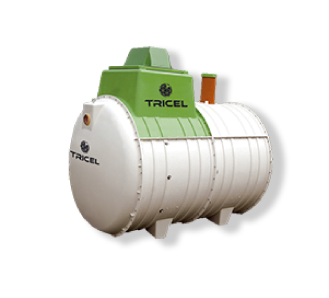
EN 12566-3 · Treatment plant · 1–50 PE
Tricel Novo Treatment Plant
Tricel's main domestic wastewater treatment plant for household and light commercial use. A three-chamber plant made from compression-moulded SMC with a shallow-dig design. Suited to homes where a septic tank is not suitable, self-builds without mains access, and replacement or upgrade projects.
Novo treatment plant overview →
EN 12566-3 · Treatment plant · 6–50 PE · NI
Tricel Vitae Treatment Plant
A domestic treatment plant available in Northern Ireland. In line with the regulations, it permits direct discharge to a watercourse (Northern Ireland only), which suits sites with poor drainage where a waterway is available rather than a soakaway. A discharge consent from NIEA is still required.
Vitae treatment plant overview →
SAF technology · Treatment plant · 50+ PE
Tricel Maxus Treatment Plant
Tricel's treatment plant for applications above 50 PE, using submerged aerated filter (SAF) technology. Modular and suitable for phased installation, it is used for housing developments, hotels, restaurants, campsites and other commercial sites where loads exceed the domestic range.
Maxus treatment plant overview →A product recommendation should come after the site, loading and consent route have been reviewed. Typical starting points include:
| Site type | Likely starting point | Notes |
|---|---|---|
| Single house | Domestic wastewater treatment | Confirm public sewer availability, ground conditions and NIEA consent route. |
| Single house discharging to a watercourse | Tricel Vitae may be reviewed | Domestic plant available in Northern Ireland; permits direct discharge to a watercourse (NI only). Suits sites with poor drainage but a nearby waterway. |
| Larger house or small shared use | Tricel Novo may be reviewed | Domestic and light commercial, 1 to 50 PE. Suitability depends on PE, site conditions and discharge route. |
| Commercial or mixed-use site | Commercial wastewater treatment | Size around actual use, not the building name alone. |
| Housing development | Project-specific review | Check NI Water position, total PE, phasing and consent route. |
| Larger commercial or shared load | Tricel Maxus may be reviewed | Above 50 PE, using SAF technology; modular and suitable for phased developments. Usually relevant where the project is above the domestic range. |
Tricel’s wastewater treatment systems page explains the main system routes, including septic tanks, domestic treatment plants, commercial treatment plants, tertiary treatment, sand polishing filters, pumping stations and related wastewater products.
Related: Wastewater treatment systems | Tricel Novo | Tricel Vitae | Tricel Maxus | Brochures and downloads
Information needed before Tricel can recommend a system
To help Tricel review a Northern Ireland wastewater project, prepare as much of the following information as possible:
Site location
Confirm that the site is in Northern Ireland and provide the address or townland.
Property type
State whether the site is a single house, commercial site, housing development, school, campsite, hotel, nursing home, rural business or mixed-use property.
Public sewer position
Confirm whether a public foul sewer connection is available or whether NI Water has been contacted.
Population equivalent and usage
Provide expected occupancy, staff numbers, visitor numbers, bedrooms, seats, pitches, pupils, residents or other usage data relevant to the site.
Wastewater sources
List toilets, showers, kitchens, laundry, cafés, washdown areas, public toilets, staff facilities and other wastewater sources.
Discharge route
Confirm whether discharge is expected to go to ground, groundwater, surface water, watercourse, public sewer or another route.
Site conditions
Provide available space, access, slope, soil conditions, water table information, nearby drains or watercourses, and any known constraints.
Project stage
State whether the project is at planning, design, consent, tender, installation, replacement, upgrade or emergency stage.
Authority correspondence
Share any NI Water, NIEA, planning, building control or consultant correspondence.
Tip: the earlier this information is reviewed, the easier it is to avoid selecting a system that is unsuitable for the consent route or discharge conditions.
Common mistakes on Northern Ireland wastewater projects
Avoid these common errors:
- Using Republic of Ireland septic tank registration wording for a Northern Ireland site
- Assuming the EPA Code of Practice route applies in Northern Ireland
- Treating NIEA consent as the same as Republic of Ireland registration
- Selecting a septic tank before checking the discharge route
- Starting with product size before confirming PE and wastewater strength
- Treating a housing development as a single domestic property
- Assuming a sewer connection removes trade effluent consent requirements
- Ignoring kitchens, laundry, washdown areas or public toilets
- Sizing a campsite, hotel or school from one simple metric
- Failing to keep consent, maintenance, servicing and desludging records
Table of Contents
Need a wastewater treatment quote for a Northern Ireland site?
Tricel and its Northern Ireland partner, Depawater, can help identify the wastewater treatment route that may be suitable for your site. Include the property use, expected wastewater load, proposed discharge route, ground conditions, consent status, and any available site or drainage reports when requesting a quotation. Technical guidance cannot determine the applicable VAT treatment, which should be checked against HMRC guidance or with a qualified tax adviser.
Tricel partner in Northern Ireland
Local wastewater support from Depawater
Depawater is Tricel’s official distributor in Northern Ireland, supplying and supporting Tricel septic tanks, wastewater treatment plants, tertiary treatment systems, and stormwater products.
Its team can assist with the project from the initial site visit and regulatory application stage through to system supply, installation, commissioning, servicing, and later upgrades.
Official Tricel distributor
Depawater supplies Tricel wastewater products for domestic, commercial, replacement, and upgrade projects in Northern Ireland.
- Tricel Vento septic tanks
- Tricel Novo and Vitae treatment plants
- Tricel Maxus commercial systems
- Tricel Tero, Sandcel, and Nero products
Site and application support
The team can assess the proposed site and assist with the technical information needed before a system is selected.
- Free initial site visits
- Percolation testing
- Consent to Discharge application assistance
- Drainage-system reports and project advice
Supply, installation, and commissioning
Depawater can manage the complete physical installation or provide only the parts of the project for which support is required.
- Domestic and commercial system supply
- Excavation and installation support
- System commissioning
- Retrofit and replacement projects
Maintenance and ongoing support
Support remains available after installation to help maintain the system and address operational or site-related problems.
- Scheduled servicing and maintenance
- System upgrades and replacement components
- Septic-tank problem investigation
- Wastewater insurance-claim management
Contact Depawater
Mowhan, Co. Armagh,
BT60 2HF, Northern Ireland
Friday: 8.30am–4.00pm
Frequently asked questions
Are wastewater regulations the same in Northern Ireland and the Republic of Ireland?
No. Northern Ireland uses a different route from the Republic of Ireland. For off-mains sites in Northern Ireland, NIEA consent to discharge and NI Water checks may be relevant. Republic of Ireland domestic septic tank registration should not be used as a substitute for Northern Ireland consent.
Do I need consent for a septic tank in Northern Ireland?
Yes, where the system discharges sewage effluent to a waterway or to underground strata. DAERA states that consent is required for a discharge of sewage effluent from a house or other premises to a waterway or to underground strata.
Who issues consent to discharge in Northern Ireland?
Consent to discharge is issued through the Northern Ireland Environment Agency route. DAERA states that septic tank systems require consent to discharge from the NIEA Water Regulation Team.
Can I use the EPA Code of Practice for a Northern Ireland site?
No. The EPA Code of Practice is a Republic of Ireland document. Northern Ireland projects should be reviewed against the Northern Ireland route, including NIEA consent to discharge and NI Water requirements where relevant.
What if a public sewer is available?
If a public sewer connection is available, it may need to be considered before a private wastewater treatment system is selected. NI Water can provide information about sewerage infrastructure availability and capacity through its pre-development enquiry route.
Does a commercial site need trade effluent consent?
It may. NI Water states that businesses wishing to discharge trade effluent into a public sewer are required by law to obtain Trade Effluent Consent, and that discharging without consent is an offence.
Is a housing development treated as a single domestic discharge?
No. DAERA states that domestic consents are for single-dwelling discharges only. For two or more dwellings, advice should first be sought from NI Water regarding connection to the public sewer network.
What system is suitable for a single house in Northern Ireland?
The answer depends on public sewer availability, site conditions, discharge route, loading and consent requirements. A septic tank or sewage treatment plant may be reviewed. For a domestic plant, the Tricel Novo covers 1 to 50 PE, while the Tricel Vitae is a domestic plant available in Northern Ireland that permits direct discharge to a watercourse (NI only). The correct system should not be selected until the site route has been confirmed.
What system is suitable for a commercial site in Northern Ireland?
Commercial sites should be reviewed around actual wastewater load, wastewater strength, peak demand, discharge route and trade effluent considerations. The correct system may be a commercial wastewater treatment plant, a larger shared system or a project-specific treatment arrangement.
What details should I send before asking for a recommendation?
Send the site location, property type, expected occupancy or PE, wastewater sources, discharge route, ground conditions, project stage and any NI Water, NIEA, planning or building control correspondence.
Can Tricel help before I apply for consent?
Yes. Tricel can help review the likely wastewater treatment route and identify what information may be needed before a product recommendation is made. Formal consent, planning and legal requirements should be confirmed with the relevant authority or appointed consultant.
Should I choose the system before checking the rules?
No. For Northern Ireland sites, confirm the sewer position, discharge route, site load, consent requirements and property use before choosing a septic tank, package sewage treatment plant or larger wastewater treatment system.
Related guides
Everything else you might need
Consent to discharge in Northern Ireland
Guidance on when NIEA consent may be needed, application routes and discharge requirements.
View consent guidance →DAERA compliance for private sewage systems
Understand DAERA and NIEA compliance routes for private sewage systems and commercial sites.
Read DAERA compliance guide →Republic of Ireland vs Northern Ireland regulations compared
Compare the main wastewater treatment, registration, consent and compliance routes across both jurisdictions.
Compare RoI and NI rules →Commercial wastewater treatment guide
Guidance for commercial, mixed-use and larger wastewater projects where domestic rules may not apply.
View commercial wastewater treatment →Septic tank regulations in Ireland
A wider guide to septic tank registration, owner responsibilities, inspections and compliance in Ireland.
Read septic tank regulations →Wastewater treatment systems in Northern Ireland
Guidance for Northern Ireland homes, commercial sites and developments, including NIEA consent, NI Water checks and system selection.
View Northern Ireland guide →Tricel Vitae
Domestic wastewater treatment plant option for Northern Ireland sites where direct discharge to a watercourse may be reviewed.
View Tricel Vitae brochure →Tricel Novo
Domestic and light commercial wastewater treatment plant option for projects from 1 to 50 PE.
View Tricel Novo brochure →Tricel Maxus
Commercial wastewater treatment plant option for larger or shared loads above the domestic range.
View Tricel Maxus brochure →Get in touch