
Uodated June 2026
Domestic Sewage Systems
Commercial Wastewater treatment
EN 12566 & S.R. 66:2015 certified
Home » Wastewater Treatment by Property Type
By Property Type
Wastewater treatment by property type
How do I choose the right wastewater treatment system in Ireland?
Choosing an off-mains wastewater treatment system depends on more than the building type. The building tells you how wastewater is generated. It does not, on its own, tell you how that wastewater should be treated or where the treated effluent can go. The correct route is set by your location, the population equivalent the site must serve, the site conditions, the suitability of the ground, the discharge route, and the level of treatment the assessor or authority requires.
Population Equivalent (PE) calculator
Estimate the Population Equivalent for a wastewater treatment project. This figure is indicative only and should be confirmed by a site assessor before any system is sized.
This figure is indicative only and needs to be confirmed by a site assessor.
By Property Type
Wastewater treatment by property type
Tricel manufactures and supplies wastewater treatment systems for domestic, residential, commercial and semi-collective sites across the Republic of Ireland and Northern Ireland. This page is a starting point rather than a specification. Begin with your property type, move to the guide that matches your project, and — where a system is needed — request a site-specific recommendation. Every route below links to a more detailed guide.
Two regulatory points shape almost every decision. In the Republic of Ireland, the Environmental Protection Agency’s 2021 Code of Practice applies to domestic wastewater treatment systems serving a population equivalent of 10 or fewer. It sets out the methodology for site characterisation, design, installation, operation and maintenance, and has applied to site assessments and installations carried out on or after 7 June 2021. In Northern Ireland, septic tanks and package treatment plants may require consent to discharge from the Northern Ireland Environment Agency. Confirming your jurisdiction early prevents specifying the wrong product or the wrong documentation.
Before you choose
The six things that decide the right system
Two sites with the same building can need different systems, and two different buildings can sometimes use the same system. Product selection follows the site, not the label on the project. Six factors do most of the work.

Location. Requirements differ between the Republic of Ireland and Northern Ireland, and the regional documentation and approval routes differ with them. Establish the jurisdiction first.
Population equivalent (PE). PE expresses the daily organic and hydraulic load a system must handle, measured relative to the load from one person. It is the common language of system sizing. A house is sized on its design occupancy; a commercial or semi-collective site is sized on the number and pattern of users it serves. Getting PE right is the difference between a system that performs and one that is overloaded.
Site assessment. In the Republic of Ireland, the EPA Code of Practice sets out how to characterise a site: a desk study, a trial hole to establish soil and subsoil conditions and the depth to bedrock and to the water table, and a percolation test to measure how readily the ground accepts water. The test result is expressed as a percolation value. The 2021 Code updated the terminology so that the surface and subsurface tests describe only where the test is carried out; the method is the same.
Ground suitability and separation distances. The percolation value, the depth of unsaturated soil or subsoil, and the minimum separation distances to wells, watercourses, boundaries and buildings together decide whether treated effluent can discharge to ground on that site, and by which method. Where the ground is unsuitable, the assessment points towards a higher level of treatment before discharge.
Discharge route. Most domestic systems in Ireland discharge treated effluent to ground through a percolation area, allowing the soil and subsoil to complete the process. Where ground conditions do not allow this, other routes and additional treatment stages may be needed. The route has to be confirmed before the tank or plant is chosen.
Treatment level. Wastewater treatment runs in stages. Primary treatment is settlement in a tank, which separates solids from liquid. Secondary treatment is a biological stage that reduces the dissolved and suspended organic load, measured as biochemical oxygen demand (BOD), ammonia and suspended solids. Tertiary treatment is a further polishing stage that reduces pathogens or nutrients, and is required on more sensitive sites such as those in water table protection zones. The assessor or authority sets the level the site requires.
Find the right wastewater route for your property
Different property types create different wastewater loads. A single house is usually assessed by domestic occupancy and site conditions, while commercial, shared, hospitality, education, healthcare, leisure and community sites may need a project-specific PE calculation. The correct system route depends on the number of users, peak loading, site characterisation, discharge route, and any local authority or licence requirements.
| Property type | Best starting page | Typical requirement |
|---|---|---|
| House, self-build or residential property | Household wastewater treatment | Single-house or residential route based on the site assessment. |
| Commercial premises | Commercial wastewater treatment | System sized to site usage, PE and discharge requirements. |
| Hotel, guesthouse or hospitality site | Hotel wastewater treatment | Variable flows from rooms, kitchens, events and seasonal occupancy. |
| School or education site | School wastewater treatment | Term-time demand, concentrated daily peaks, staff use and canteen activity. |
| Campsite, caravan park or glamping site | Campsite sewage system | Seasonal and fluctuating occupancy, pitch use, showers, toilets and visitor facilities. |
| Housing development or residential scheme | Housing development wastewater treatment | Shared system sized on total PE, phasing and future occupancy. |
| Garden centre or mixed-use rural site | Rural business wastewater treatment | Visitor facilities, cafés, retail areas and mixed rural-site flows. |
| Restaurant, café or pub | Restaurant, café and pub wastewater treatment | High service-period demand, kitchen wastewater and grease management. |
| Nursing home or care facility | Nursing home wastewater treatment | Continuous occupancy, laundry, kitchen use, staff shifts and reliability requirements. |
| Community and visitor facility wastewater treatment | Community and visitor facility wastewater treatment | Intermittent use, event peaks, public toilets, changing rooms and seasonal visitors. |
Example : a four-bedroom house is normally assessed as 6 PE. This means the wastewater treatment system should be selected to treat the expected wastewater load for a 6 PE property, not only the current number of occupants.
Domestic & Residential Wastewater Treatment
Use the domestic and residential route if the project is a one-off house, a self-build, a rural dwelling, a replacement system or a residential upgrade. This is the most common route for off-mains homes across Ireland, and it is where the EPA Code of Practice has the most direct effect.
Selection begins with the site assessment, not the product. In the Republic of Ireland, the 2021 Code of Practice provides guidance for domestic wastewater treatment systems up to 10 population equivalent, covering site characterisation, design, operation and maintenance. Systems of this size discharging to ground are managed through the Code of Practice, planning and building regulations rather than through a separate groundwater discharge licence.

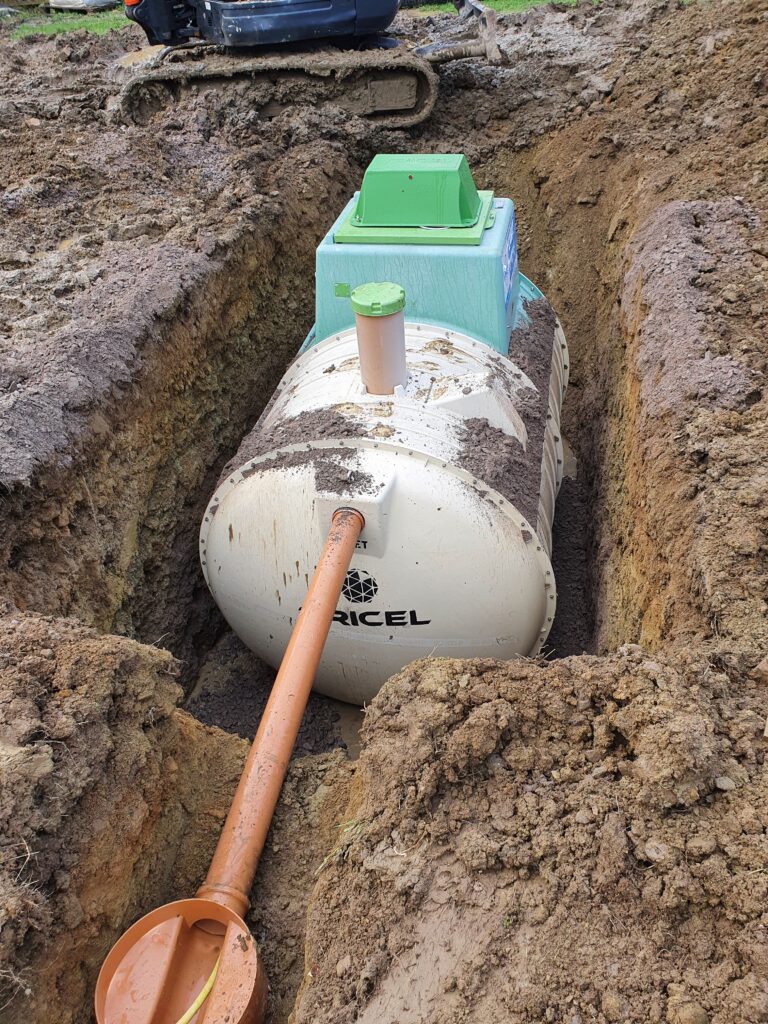
The recommended route depends on the site. On a site with suitable ground and adequate percolation, a septic tank providing primary treatment, followed by a percolation area, may be appropriate. Where the ground is less suitable, or where the assessment calls for a higher standard of effluent, a packaged wastewater treatment plant providing secondary treatment is used, sometimes followed by a sand polishing filter or another tertiary stage. Some sites also require a pumped arrangement where the layout or levels do not allow flow by gravity.
Within the Tricel range, the Vento septic tank provides primary treatment, and the Novo packaged treatment plant provides secondary treatment and is certified to I.S. EN 12566-3, the European standard for packaged and site-assembled domestic wastewater treatment plants serving up to 50 population equivalent. That standard tests a plant as a whole and reports its performance as BOD, ammonia and suspended solids. Product choice depends on the population equivalent and the site conditions, not on the project type alone.
Planning a home wastewater system? :Speak to Tricel before selecting a tank, treatment plant or polishing filter. Read the domestic guide.
Commercial wastewater treatment
Use the commercial route for off-mains businesses, rural commercial premises, housing developments, hospitality sites, retail units, restaurants, factories and other non-domestic projects. These sites usually fall outside the scope of the domestic Code of Practice and are sized directly to their actual use.
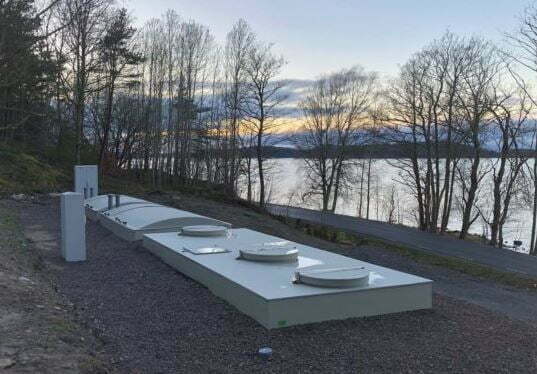
Tricel Maxus commercial wastewater treatment systems are designed for applications greater than 50 population equivalent and use submerged aerated filter technology. Listed applications include hotels, schools, factories, housing estates, garden centres, petrol stations, restaurants, caravan parks, campsites and retail units. Because the same product family serves a wide range of sites, the sizing work matters more than the category.
A commercial system must be matched to the site. That means confirming the expected daily flow, the organic loading, the peak demand, any seasonal pattern, the required effluent standard, the discharge route, and any planning or licensing requirement that applies to a development of that size. A system sized only on headline occupancy, without the peak and seasonal picture, risks either overloading at busy times or running well below its design point when quiet.
Need a wastewater system for a commercial site? : Request a site-specific quote.
Hotel wastewater treatment
Hotels and hospitality sites have variable wastewater demand. A quiet weekday, a full weekend, a wedding, a conference and peak tourist season each place a different load on the system. A hotel system should be designed to allow for these variable flows and loadings, because overloading at peak times can raise BOD, ammonia and suspended solids in the effluent, which in turn can create compliance issues.
The design has to reflect both the busy days and the quiet ones. A plant sized only for average demand may struggle during events, while a plant sized only for the single busiest weekend of the year may be poorly loaded for most of the season. A hotel wastewater specification should account for:
- Number of bedrooms
- Restaurant and kitchen use
- Bar and event facilities
- Staff facilities
- Laundry, if present
- Seasonal occupancy
- Peak event days
- Discharge requirements

Planning a hotel upgrade or a new hospitality site? : Ask Tricel to review the PE, peak loads and treatment route. Read the hotel guide.
School, Creche & Childcare Wastewater Treatment
Wastewater treatment for schools, creches, childcare centres and education sites, sized around pupils or children, staff, opening patterns, kitchens or canteens, daily peaks, term-time use, holiday periods and discharge route.

Need a wastewater system for a school or education site? Request advice before finalising the design.
Campsite Sewage System & Wastewater Treatment
Off-mains sewage and wastewater treatment for campsites, caravan parks, holiday parks and glamping sites, sized around seasonal occupancy, pitch use, showers, toilets, laundry, visitor facilities, discharge route and site conditions..
For sites of this scale, the Tricel Maxus wastewater treatment plant is designed for small communities and commercial properties greater than 50 PE, with configurations for different site requirements. A campsite wastewater design should consider:
- Number of pitches, cabins or units
- Shower and toilet blocks
- Laundry facilities
- Reception, café or shop use
- Seasonal peaks
- Event or bank-holiday demand
- Future expansion
- Access for servicing and desludging

Planning or expanding a campsite? Speak to Tricel before confirming the wastewater capacity. Read the campsite guide.
Housing development wastewater treatment
Housing developments and small residential schemes may require a shared wastewater treatment system where a mains sewer connection is not available. Rather than a system per house, the scheme is treated as a single site and assessed on its total population equivalent across all dwellings. That total usually sits above the 10 PE domestic threshold, so the scheme is designed and sized as a semi-collective site rather than under the domestic route.
Because a development is built over time, phasing matters. The design should account for how many units are occupied at each stage, so the system performs while the scheme fills rather than only at full occupancy. The shared infrastructure — collection network, pumping where levels require it, and the treatment plant itself — is planned around the completed development and its expected future occupancy.

The discharge arrangement is assessed for the whole site: the available ground, the percolation area needed for the full load, the discharge route, and the treatment level the assessor or authority requires. Adoption, ownership and long-term maintenance responsibility for a shared system should also be settled early, since these affect servicing access and running arrangements once residents move in. For schemes above 50 population equivalent, the Tricel Maxus range covers semi-collective sites of this scale.
A housing development wastewater review should consider the number of dwellings and bedrooms, the total and phased population equivalent, the collection and pumping arrangement, ground suitability and the percolation area, the discharge route, future occupancy and expansion, maintenance access and ownership, and any planning or consent requirement.
Planning a residential scheme? Read the housing development guide.
Rural Business Wastewater Treatment
Wastewater treatment for garden centres, farm shops, equestrian centres, depots, workshops and mixed-use rural enterprises with staff facilities, visitor toilets, cafés, retail areas, seasonal footfall and varied site use.
Need wastewater treatment for a garden centre or mixed-use rural site? Request a site-specific recommendation.
Restaurant, café and pub wastewater treatment
Wastewater TreatmentWastewater treatment for restaurants, cafés, pubs and food-led premises, accounting for kitchens, grease management, service-period peaks, customer toilets, staff use, wastewater strength and discharge requirements.
Fitting out a restaurant, café or pub? Read the restaurant, cafe, pub guide.
Nursing home and care facility wastewater treatment
Nursing homes and care facilities usually have continuous occupancy and high daily wastewater use. The system should account for residents, staff, kitchens, laundry, visitor use, any medical or care-related facilities, and the consistent daily loading that comes with round-the-clock occupancy. Reliability and straightforward servicing carry extra weight where the building is occupied at all times.
Community and Visitor Facility Wastewater Treatment
Community and visitor facilities often have irregular use, with quiet periods followed by short, high-demand peaks. Sports clubs, GAA clubs, community halls, parish facilities, churches, visitor centres and tourist attractions may need to account for changing rooms, showers, toilets, clubhouses, kitchens, events, match days, training sessions, seasonal visitors and public use. The system should be assessed around real usage patterns, peak attendance, wastewater strength, discharge route and site conditions, rather than average daily use alone.
Upgrading a clubhouse or grounds? Read the sports club and community facility guide
How Tricel helps you choose the right system
Tricel can review your wastewater requirements and guide you towards the correct product category. The final selection should rest on the site assessment, the population equivalent, the ground conditions, the discharge requirements and the relevant local authority or regulatory requirements. To make the first review useful, please provide:
- Property type
- Site location: Republic of Ireland or Northern Ireland
- Number of users, residents, guests, pupils, pitches or staff
- Whether the site is domestic, commercial or semi-collective
- New build, replacement or upgrade
- Site assessment details, if available
- Discharge route
- Planning or consent status
- Required timeframe
Ireland and Northern Ireland: confirm location first
Wastewater requirements differ between the Republic of Ireland and Northern Ireland. Product naming, documentation, approvals and discharge requirements may also differ, so location should be confirmed before selecting a system or preparing a quotation.
In the Republic of Ireland, domestic wastewater treatment systems up to 10 population equivalent are guided by the EPA Code of Practice. In Northern Ireland, septic tanks and package treatment plants may require consent to discharge from the Northern Ireland Environment Agency.
| Requirement area | Republic of Ireland | Northern Ireland |
|---|---|---|
| Main guidance / authority | Domestic wastewater treatment systems up to 10 PE are guided by the EPA Code of Practice for Domestic Waste Water Treatment Systems . | Private sewage systems, including septic tanks and package treatment plants, may require consent from the Northern Ireland Environment Agency . |
| Domestic threshold | The EPA Code of Practice applies to domestic wastewater treatment systems with a population equivalent of 10 or fewer. | NIEA authorisation may be required before discharging sewage, effluent or contaminated run-off to surface water or groundwater. |
| Site assessment | Site characterisation, ground conditions, design, operation and maintenance are covered by the EPA Code of Practice. | The proposed discharge route, receiving environment and consent requirement should be checked before installation or operation. |
| Discharge consent | Requirements depend on the site, system type, discharge route and local authority or planning conditions. | Discharge consent, groundwater authorisation or another NIEA permit may be required before discharge. |
| Product documentation | Use Republic of Ireland product documentation, declarations and site assessment guidance. | Use Northern Ireland product documentation and confirm whether NIEA consent documentation is required. |
| Before selecting a system | Confirm PE, site suitability, ground conditions, discharge route and EPA Code of Practice requirements. | Confirm whether the site requires consent or authorisation from NIEA before discharge. |
Before choosing a wastewater system, confirm:
- whether the site is in the Republic of Ireland or Northern Ireland;
- whether the project is domestic, commercial or semi-collective;
- the population equivalent;
- the site assessment findings;
- the proposed discharge route;
- any planning, consent or licence requirement;
- the correct product documentation for that jurisdiction.
This check should happen before product selection, quotation or installation planning.
Table of Contents
Questions about sizing a wastewater treatment system in Ireland
Choosing a wastewater treatment system depends on your site, location, property type, ground conditions and discharge requirements. These FAQs explain the main differences between septic tanks, treatment plants, polishing filters and pumping stations, and help you understand what information is needed before selecting a Tricel system.
What size sewage treatment plant do I need for a 3-bedroom house?
A three-bedroom house is typically assessed as 5 PE for domestic wastewater sizing. The final system should still be confirmed by a qualified site assessor or wastewater professional.
What size sewage treatment plant do I need for a 4-bedroom house?
A four-bedroom house is typically assessed as 6 PE. Depending on the site and required treatment type, a Tricel Novo IE6 or IE6+ may be considered.
What does 6 PE mean?
6 PE means the wastewater system is designed for a population equivalent of six people. PE is a wastewater load measure, not just a count of the current occupants.
Is PE the same as the number of people living in the house?
No. PE is a design figure used to size the wastewater system. For single houses, it is normally based on the number of bedrooms so that the system allows for expected occupancy over time.
Can I install a larger sewage treatment plant than required?
Not always. A plant that is too large may not receive enough regular wastewater load to perform as designed. The system should be matched to the calculated PE and confirmed against the site assessment.
What is the difference between a septic tank and a sewage treatment plant?
A septic tank provides primary treatment and relies on a suitable disposal or further treatment system. A sewage treatment plant provides secondary biological treatment before discharge to a suitable discharge area.
What size septic tank do I need?
For Tricel Vento, the listed septic tank options are 6 PE, 12 PE and 20 PE. The correct model depends on the design population and the site assessor’s recommendation.
What if my project is over 50 PE?
Projects over 50 PE should be assessed as commercial wastewater treatment projects. Tricel Maxus is the relevant Tricel range for 50+ PE applications.
Do I need a site assessment before choosing the system?
Yes. A site assessment is needed to confirm whether the proposed wastewater treatment and discharge route is suitable for the site.
Is this guide for Ireland or Northern Ireland?
This page is primarily for Ireland and references the EPA Code of Practice. Northern Ireland projects should be routed separately because product naming, approval requirements and documentation will differ.
Related resources
Everything else you might need
Grants & funding
Eligibility, the 85% / €12,000 grant, and how to apply after a failed inspection.
Grants guide →Cost & pricing guide
A fuller breakdown of product, installation and groundworks costs by system type.
Read the cost guide →Find an installer
Regional installer and distributor network across the seven highest-demand counties.
Find an installer →Service & desludging plans
One to ten-year service agreements, from €195, covering travel and servicing labour.
View service plans →Site assessment
Use the free Tricel Site Assessor tool to check which wastewater treatment system category your site may fall under, based on the EPA Code of Practice
Start assessment →Case studies
Recent domestic and commercial installations, by county and sector.
Browse case studies →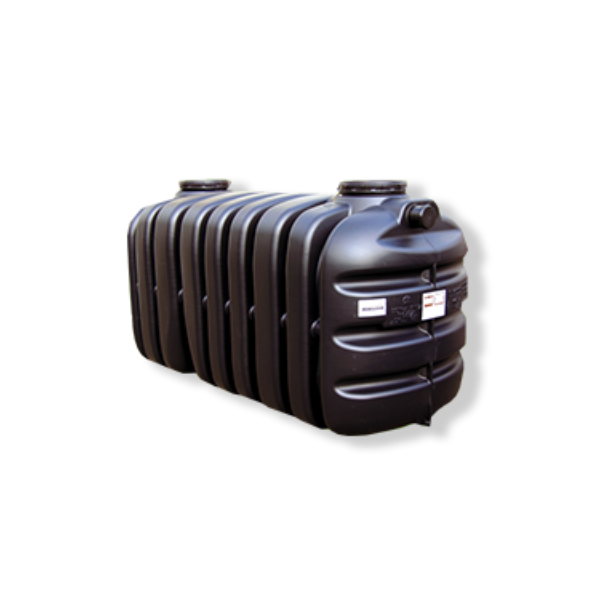
Tricel Vento Septic Tank
Shallow dig tank, strong & robust underground tank, No electrical or moving parts. Ideal for sites with good drainage & plenty of space.
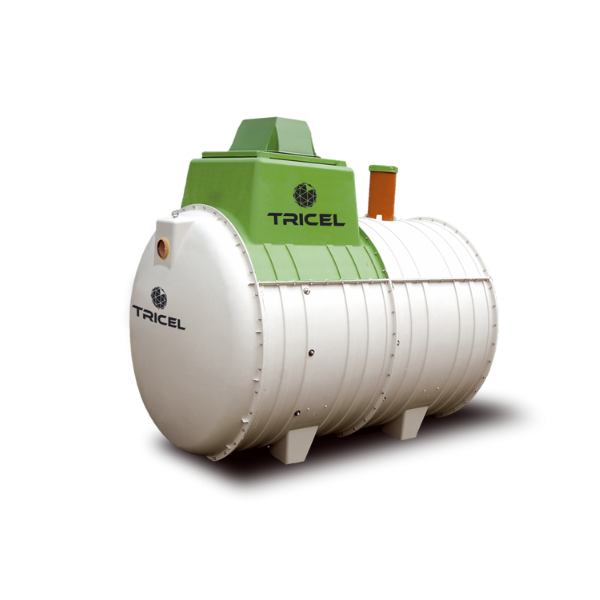
Tricel Novo Sewage Treatment Plant
Durable & long lasting SMC tank, shallow dig tank, easy installation (Plug and Play), long life components.
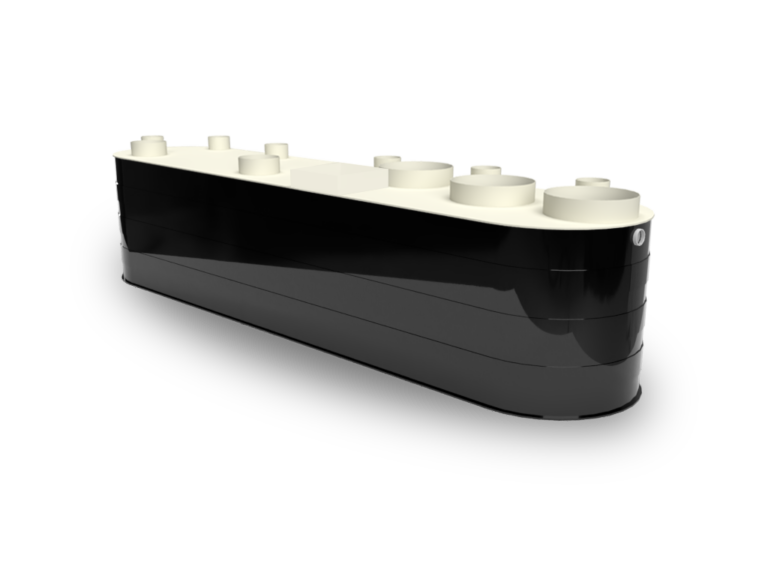
Tricel Maxus Sewage Treatment Plant
Commercial plant. Submerged Aerated Filter (SAF) technology. Ideal for project over 50 PE.
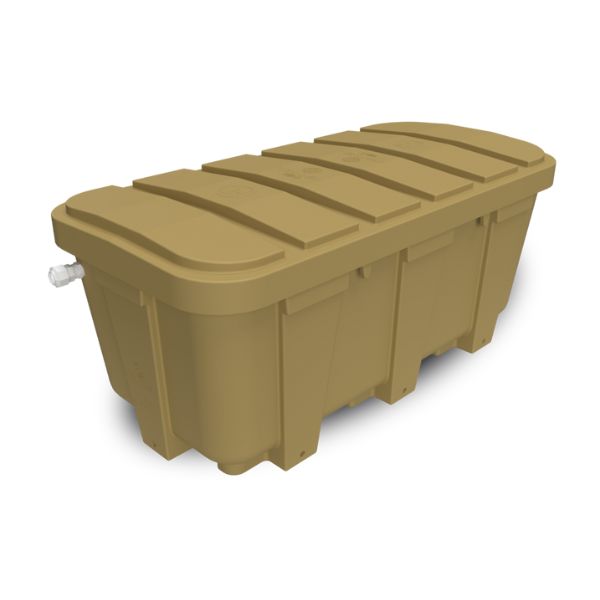
Tricel Tero Tertiary Treatment
An eco-friendly and modular system with proven E.Coli Treatment capabilities in line with the new EPA requirements.
Tricel Puraflo Secondary treatment plant
Ideal for sensitive sites, compliant to Irish Standard, small footprint.
Tricel Sandcel
Sand Polishing Filter
Provides a dual function of polishing the effluent from a wastewater treatment system and disposing it into groundwater.
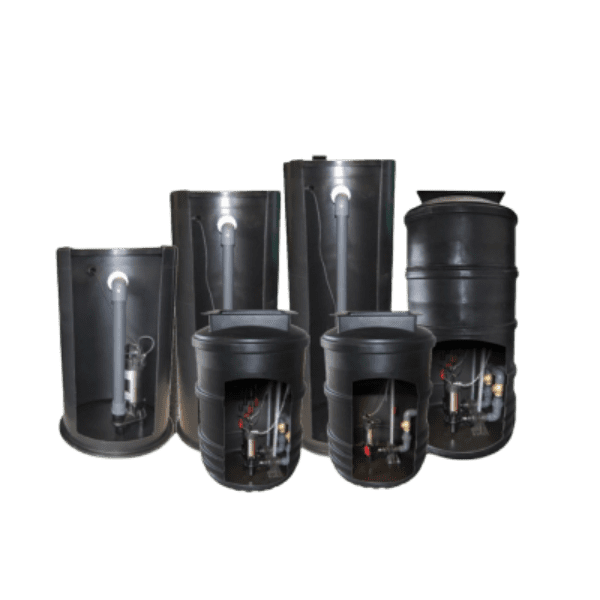
Tricel Pumping Stations
Pump fluids from one place to another where gravity drainage cannot be used, easy and trouble-free installation
50 years in business
A highly successful multinational corporation with over 50 years’ valuable industry experience
SEWAGE TREATMENT PLANTS
Plants available for all capacities, from 1PE up to 50PE. Free advice on request.
Fast Delivery
On-time delivery is a core requirement of our successful business operations
Meet our team
To find a technician in your area, visit our page
TALK SEWAGE TREATMENT
To speak to one of our agents online, click here
ASK FOR A QUOTE
Request a free quote today to have a quote that meets your project!
Get in touch